
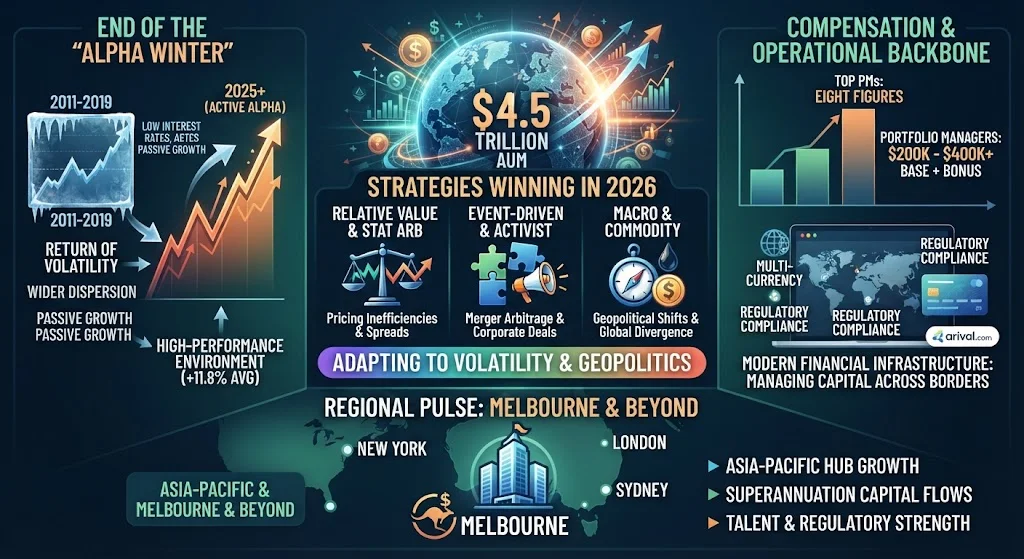
The global hedge fund industry, now managing an estimated $4.5 trillion in assets, has entered a new era defined by normalized interest rates, geopolitical shifts, and heightened market volatility. For institutional investors and financial professionals, understanding this evolving landscape is no longer optional — it is essential. The rules that governed hedge fund success for the past decade have been rewritten, and the winners in 2026 are those who adapt fastest.
The End of the "Alpha Winter"
Between 2011 and 2019, the hedge fund industry endured what many called an "alpha winter." Central banks held rates near zero, equity markets climbed almost without interruption, and passive strategies delivered respectable returns without the burden of high fees. Active managers struggled to justify their existence, and capital flowed steadily toward index funds.
That dynamic has reversed. As rates normalized, volatility returned, and dispersion across individual securities widened. According to industry data, 2025 marked the second consecutive year of double-digit returns for hedge funds, with average performance reaching roughly +11.8%. Managers who could identify specific opportunities rather than simply tracking the market were suddenly in demand again.
J.P. Morgan Asset Management has described this shift as the "end of the alpha winter." Normalized rates, elevated single-stock volatility, and greater market dispersion have created a durable foundation for alpha generation — and, by extension, a far more attractive environment for hedge funds.
Strategies Winning in 2026
The hedge fund universe is not monolithic. Different strategies respond differently to current conditions, and several are clearly outperforming.
Relative Value and Statistical Arbitrage
Elevated volatility has created rich opportunities in relative value strategies. Statistical arbitrage funds, which exploit pricing inefficiencies between related securities, have benefited from wider spreads and more frequent dislocations. These strategies tend to perform best when markets are fragmented rather than uniformly directional.
Event-Driven and Activist Approaches
Merger arbitrage and activist campaigns have also gained traction. With geopolitical shifts reshaping supply chains and corporate strategies, companies are increasingly forced into transformative deals. Event-driven managers who can accurately assess regulatory risk and deal timelines have captured significant premiums.
Macro and Commodity Strategies
Geopolitical instability and divergent central bank policies have made macro strategies particularly relevant. Currency dislocations, commodity supply shocks, and shifting rate differentials offer fertile ground for discretionary and systematic macro funds alike. Many of the best-performing funds in 2025 specialized in exactly these areas.
Compensation: What Managers Are Earning Now
Compensation in the hedge fund industry has always been closely tied to performance, and 2026 is no exception. The classic "2 and 20" model — a 2% management fee and 20% performance fee — remains a benchmark, but it is under pressure. Institutional investors, emboldened by a decade of mediocre returns, have negotiated fees downward in many cases, particularly for large allocations.
At the same time, top-performing managers have regained pricing power. Funds that delivered strong returns in 2024 and 2025 are once again able to command premium fees. Compensation for portfolio managers and analysts has followed suit: base salaries have risen modestly, but performance bonuses have grown substantially at funds that hit their high-water marks.
According to industry surveys, a typical portfolio manager at a mid-sized hedge fund now earns a base salary in the range of $200,000 to $400,000, with performance bonuses that can multiply total compensation several times over. At elite multi-manager platforms, top portfolio managers can earn well into the eight figures in strong years.
The Operational Backbone: Managing Money Across Borders
As hedge funds grow more global, operational complexity has increased. Managers must handle multi-currency exposure, cross-border capital movements, and increasingly stringent regulatory requirements. This is where modern financial infrastructure plays a critical role.
Platforms that allow funds and their principals to hold USD and other currencies, move stablecoins efficiently, and spend with cards from anywhere have become essential tools for managing global operations. One platform for all your money is no longer a luxury — it is a practical necessity for funds operating across multiple jurisdictions. Solutions like arival.com are increasingly part of the operational stack for professionals who need to move capital quickly and transparently while maintaining control over multi-currency balances.
The Melbourne Pulse: A Regional Perspective
While New York and London remain the traditional centers of the hedge fund world, regional hubs are gaining prominence. Melbourne, in particular, has emerged as a significant center for hedge fund activity in the Asia-Pacific region. The city's proximity to Asian markets, its strong regulatory framework, and its deep pool of financial talent have attracted both established funds and new startups.
Australian hedge funds have benefited from the country's mandatory superannuation system, which channels substantial capital into alternatives. Melbourne-based managers have been particularly active in event-driven and relative value strategies, often focusing on Australian and Asian equities. The city's hedge fund community remains smaller than Sydney's, but it is growing steadily, with several funds achieving notable track records in recent years.
Performance Fees Under Scrutiny
The debate over performance fees has intensified. Critics argue that the traditional 20% performance fee creates asymmetric incentives, allowing managers to profit from beta while investors bear the downside. In response, many funds have adopted hurdle rates, high-water marks, and clawback provisions to better align interests.
Some of the most innovative structures now include tiered performance fees, where the manager receives a lower percentage on the first tranche of returns and a higher percentage only after exceeding a meaningful benchmark. This approach has been welcomed by institutional investors who want to reward genuine skill rather than market exposure.
Looking Ahead: What to Watch
Several factors will shape the hedge fund industry over the next 12 to 18 months. Central bank policy remains the single largest variable: any shift toward rate cuts could compress the alpha opportunities that have recently emerged. Conversely, persistent inflation or geopolitical shocks could extend the current favorable environment for active managers.
Technology will also play a growing role. Artificial intelligence and machine learning are transforming everything from trade execution to risk management. Funds that successfully integrate these tools are likely to gain a competitive edge, particularly in quantitative and systematic strategies.
Finally, the ongoing consolidation of the industry is expected to continue. Larger platforms with diversified strategies and robust infrastructure are attracting the majority of new capital, while smaller funds face increasing pressure to differentiate or shut down. For investors, this means fewer choices but potentially higher quality.
Conclusion
The hedge fund industry in 2026 is healthier and more dynamic than it has been in years. The end of the alpha winter has restored the appeal of active management, and the best managers are delivering returns that justify their fees. At the same time, the bar has been raised: operational excellence, global flexibility, and genuine skill are now table stakes.
For investors, the opportunity set is broader than ever. For managers, the challenge is to prove that their alpha is real — and to build the infrastructure that allows them to capture it across borders and currencies. The funds that succeed will be those that combine investment insight with operational discipline, navigating an increasingly complex world without losing sight of the fundamentals that have always driven performance.
Share this Post
latest post
-

-
 Anonymous Chatting as a Modern Way to Socialize June 8, 2026
 -

-
 Navigating the Landscape of Hedge Fund Strategies October 3, 2025
 -
 Hedge fund CFO Compensation August 20, 2017
 -
 Hedge fund Melbourne June 5, 2017
 -
 Steel Partners hedge fund June 9, 2018
 -
 Hedge fund performance fees April 1, 2019
 -
 Top hedge funds New York April 26, 2016